
Mud Island Community Garden
  • Link to Facebook
  • Link to Youtube
  • Link to Instagram
  • Link to X
  • Home
  • The Garden
    • How does the garden work?
    • Growing through the seasons
    • Our History
    • Growing Communities
    • Gallery
    • Media/Awards
  • Join Us
    • Mud Island Code of Behaviour
    • Garden Rules and Constitution
  • Events & Workshops
    • Upcoming Events & Workshops
    • Past Events & Workshops
  • Circular
    • Library Of Things
  • News & Resources
  • Support Us
  • Contact Us
  • Click to open the search input field Click to open the search input field Search
  • Menu Menu

Biodiversity in our urban community garden

1. Native hedge

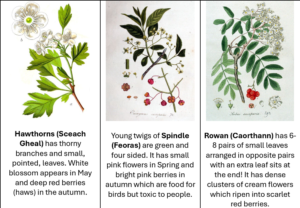
We planted our native hedge this Spring with Hawthorn (Sceach Gheal), Rowan (Caorthann), and Spindle (Feoras) saplings. As our native hedge grows, it will provide food and shelter for animals that visit the garden – bees, butterflies, ladybirds, hoverflies and other insects, and birds such as the robin, sparrow and blackbird. Thrushes love Rowan berries and they are important food for many birds in the winter. The insects that visit the hedge will also pollinate the garden’s fruits and vegetables and help us to get good crops. In the autumn, we can make jelly and jam from the Hawthorn haws and Rowan berries. In 5-10 years, the hedge will be large enough to give us some shade in the hot weather. Use the QR code to learn how to identify our native hedge trees.

How to identify the trees in our native hedge Native Irish Trees

Tree Council of Ireland, Tree Register of Ireland, Tree Conservation
2. Pond

A pond, even a small one, is one of the best ways to support wildlife in the garden. Many insects live part or all of their life underwater, for example, damselflies, dragonflies, pond skaters, and whirligig beetles. Frogs need a safe, shallow and fish-free pond to lay spawn in. Birds, bats and pollinating insects like bees use them for water. The ferns, leaf litter and log piles near the pond provide a great place for visiting wildlife to rest. Dead wood also supports many other native animals, plants and fungi. Clearing back some of the horsetail and duckweed plants in our pond will help more wildlife to use it. Use the QR code to learn more about wildlife and garden ponds.

National Biodiversity Data Centre, “10 Ways to Help Biodiversity”

National Biodiversity Data Centre, “Dameselflies and Dragonflies”

Pond Conservation “Creating GARDEN PONDS for wildlife”

Juanita Browne, “Gardening For Biodiversity” Laois County Council

3. Wildflowers

Wildflowers are the best source of nectar and pollen for our local bees and other pollinating insects. Can you find four native wildflowers that are flowering right now in our raised banks? Buttercups, Knapweed, Ox-eye Daisy and Common Ragwort. We can manage this raised bank area to see more wildflowers. We can weaken the grass by cutting back in the autumn and removing the cuttings, and by sowing Yellow Rattle. We can also create patches of bare earth and collect and sow seeds in them from the wildflowers already here. We must always remember to leave some areas of the bank alone as food, shelter and nesting/hibernation places for wildlife.

Creeping Buttercup • Clover • Ox-eye Daisy • Dandelion • Broad-leaved Dock • Common Knapweed • Ribwort Plantain • Common Ragwort
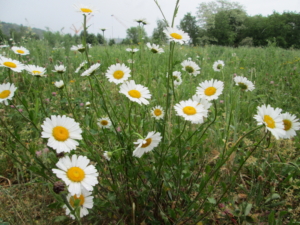
Oxeye Daisy (Nóinín mór) The yellow centre of the Oxeye Daisy is made up of many small flowers. They provide a rich source of nectar for butterflies, hoverflies and bees, especially solitary bees such as the Grey Mining Bee (Beach Tholltach Liath).
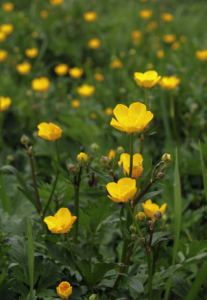
Creeping buttercup (Fearbán reatha)
© Jörg Hempel Creeping buttercup is very common and widespread. It flowers from May to August. Short-tongued bees, like the Buff-tailed Bumblebee (Bumbóg Earr-Dhonnbhuí), can reach its nectar and pollen because the flower is open with a flat shape.
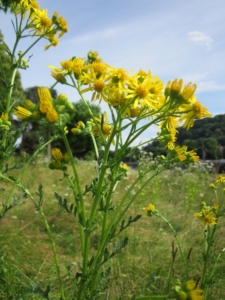
Common Ragwort (Buachalán buí)
Over 140 different insects feed and lay their eggs on Common Ragwort,  and it is a vital plant in the lifecycle of nine moths in Ireland, including the Cinnabar moth. Ragwort is poisonous to livestock which can be a problem on farms.
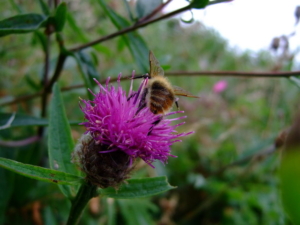
Common Knapweed (Minscoth)
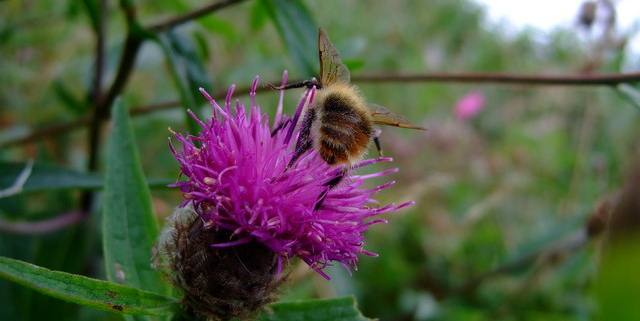
© ceridwen Common Knapweed is a valuable plant for pollinators, especially bumblebees. The rare Great Yellow Bumblebee depends on late flowering Common Knapweed in the autumn. Common Knapweed is very attractive to many moths and butterflies, including the Six-spot Burnet Moth and the Common Blue and Meadow Brown butterflies. If left to stand in the autumn and winter, the seedheads can be a great food source for birds like the Goldfinch.

More info HERE

4. Untidy patch

Perhaps we need to re-think our ideas of tidiness? This area is a high value “untidy patch”. Brambles (Dris), Nettles (Neantóg), Ivy (Eidhneán) and Bindweed (Ainleog) are all vigorous plants that can be hard to manage. They are often unappreciated by gardeners, but they provide an incredible sanctuary for many pollinating insects, birds, and small mammals.

Nettles are important caterpillar food plants for several butterflies including the Red Admiral, Small Tortoiseshell, Peacock and Comma. Ivy and brambles are incredible sources of nectar for honeybees, bumblebees and other flower-visiting insects. They flower late into the autumn when few other sources are available, helping bumblebee queens and adult butterflies build up fat reserves before hibernation or migration. Ivy is also the main foodplant of the Holly Blue. Bramble’s dense thorny cover provides shelter and safety for small mammals like hedgehogs. Foxes, badger, and garden birds enjoy blackberries and disperse the seeds. Bindweed’s leaves are a food source for some beetles and the caterpillars of moths, including the hawk-moth. It’s white trumpet flowers are visited by many pollinators, attracting bees, butterflies, and hoverflies

More reading

Gardens Actions to help pollinators 

Top Ten Pollinator plants

Nature Thrives at Mud Island Community Garden!

Biodiversity in Ireland

Gardening for biodiversity


All images are Public Domain, https://commons.wikimedia.org

Important Links

  • How does the garden work?
  • Events & Workshops
  • Join Us
  • Support Us
  • News & Resources
  • Mud Island Code of Behaviour
  • Garden Rules and Constitution

Important Links

  • How does the garden work?
  • Events & Workshops
  • Join Us
  • Support Us
  • News & Resources
  • Mud Island Code of Behaviour
  • Garden Rules and Constitution

Categories

  • Arts & EntertainmentPhotography
  • Biodiversity
  • Building
  • Creative Workshops
  • Gardening
  • Local News
  • Market
  • News
  • Our Members
  • Past Events
  • Recipes
  • Uncategorised

Latest News

  • Happy caterpillars feeding on nettle at the garden perimeter.
    Biodiversity in the garden – April / May5 May 2026 - 10:45 am

    Mud Island Community Garden Biodiversity Action Group (BAG) met for the 1st time on Sat April 18th. We shared a sense of collective hope from taking positive action to promote […]

  • Community Gardens for inclusion: Exploring the role of informal and formal spaces for refugees and asylum seekers in Ireland27 February 2026 - 1:59 pm

    ‘Shared community spaces help displaced people feel valued, connected, and push for fairer systems and support’ Meabh Bonham Corcoran, 2026. Read the article HERE

© Copyright - Mud Island Community Garden | Login
  • Link to Facebook
  • Link to Youtube
  • Link to Instagram
  • Link to X
  • Cookie Policy
Scroll to top Scroll to top Scroll to top
We use cookies on our website to give you the most relevant experience by remembering your preferences and repeat visits. By clicking “Accept All”, you consent to the use of ALL the cookies. However, you may visit "Cookie Settings" to provide a controlled consent.
Cookie SettingsAccept All
Manage consent

Privacy Overview

This website uses cookies to improve your experience while you navigate through the website. Out of these, the cookies that are categorized as necessary are stored on your browser as they are essential for the working of basic functionalities of the website. We also use third-party cookies that help us analyze and understand how you use this website. These cookies will be stored in your browser only with your consent. You also have the option to opt-out of these cookies. But opting out of some of these cookies may affect your browsing experience.
Necessary
Always Enabled
Necessary cookies are absolutely essential for the website to function properly. These cookies ensure basic functionalities and security features of the website, anonymously.
CookieDurationDescription
cookielawinfo-checkbox-advertisement1 yearSet by the GDPR Cookie Consent plugin, this cookie is used to record the user consent for the cookies in the "Advertisement" category .
cookielawinfo-checkbox-analytics11 monthsThis cookie is set by GDPR Cookie Consent plugin. The cookie is used to store the user consent for the cookies in the category "Analytics".
cookielawinfo-checkbox-functional11 monthsThe cookie is set by GDPR cookie consent to record the user consent for the cookies in the category "Functional".
cookielawinfo-checkbox-necessary11 monthsThis cookie is set by GDPR Cookie Consent plugin. The cookies is used to store the user consent for the cookies in the category "Necessary".
cookielawinfo-checkbox-others11 monthsThis cookie is set by GDPR Cookie Consent plugin. The cookie is used to store the user consent for the cookies in the category "Other.
cookielawinfo-checkbox-performance11 monthsThis cookie is set by GDPR Cookie Consent plugin. The cookie is used to store the user consent for the cookies in the category "Performance".
viewed_cookie_policy11 monthsThe cookie is set by the GDPR Cookie Consent plugin and is used to store whether or not user has consented to the use of cookies. It does not store any personal data.
Functional
Functional cookies help to perform certain functionalities like sharing the content of the website on social media platforms, collect feedbacks, and other third-party features.
Performance
Performance cookies are used to understand and analyze the key performance indexes of the website which helps in delivering a better user experience for the visitors.
Analytics
Analytical cookies are used to understand how visitors interact with the website. These cookies help provide information on metrics the number of visitors, bounce rate, traffic source, etc.
Advertisement
Advertisement cookies are used to provide visitors with relevant ads and marketing campaigns. These cookies track visitors across websites and collect information to provide customized ads.
Others
Other uncategorized cookies are those that are being analyzed and have not been classified into a category as yet.
SAVE & ACCEPT
Powered by CookieYes Logo