
Biodiversity survey of flora in the verges of Mud Island Community Garden: Summer 2026
Summary
The Biodiversity Action Group surveyed and observed flora in the verges surrounding Mud Island
Community Garden on 18 July 2026, following an initial survey in November 2025.
41 plant species were identified, 65% (27) of these were native, including 8 top ‘pollinator-friendly’1
plants. The Garden’s verges remain a valuable habitat in the North Strand, providing food and shelter
for native wildlife from early spring to late autumn.
(1. Top Ten pollinator plants for different situations. All-Ireland Pollinator Plan, How-to Guide 10. National
Biodiversity Data Centre Series No.29. November 2022. Available at pollinators.ie)
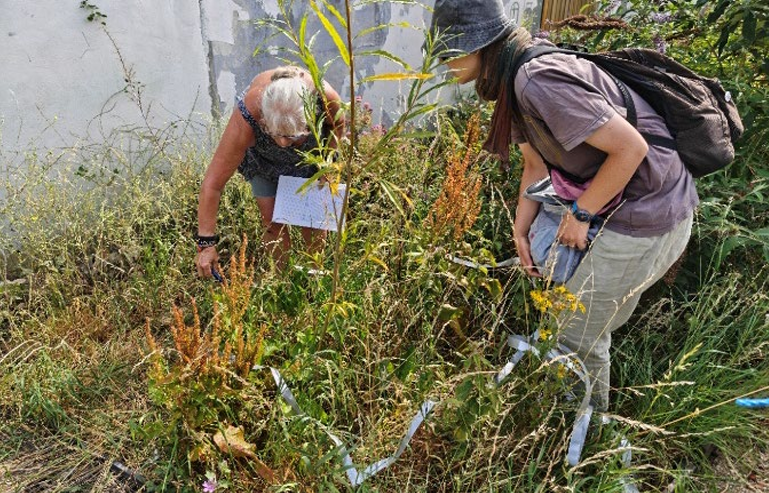
Carrying out the flora survey
Survey method
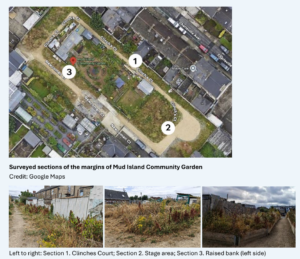
14 one metre2 quadrats were assessed from three sections:
1. Section 1: Long verge along Clinch’s Court (5 quadrats, broken transect)
2. Section 2: A bank surrounding the stage area at Newcomen Court (3 quadrats, randomly
selected from 3 sides near the path)
3. Section 3: Raised bank between Newcomen Court and Community Garden (6 quadrats,
broken transect
A follow-up walk around the verges identified additional species that had not been surveyed. Plants
were identified using prior knowledge, apps and cross-checking with “The Wildflowers of Ireland” by
Zoe Devlin.
Results
41 plant species were identified in total. 19 species were identified in the surveyed areas. 74% (14) of
these were native species.
Seven of the native species observed are described as important “pollinator-friendly”plants by the
National Biodiversity Data Centre1:
• Common Knapweed (Centaurea nigra)
• Creeping Thistle (Circense arvense)
• Dandelion (Taraxacum officinale agg .)
• Elder (Sambucus nigra)
• Hawthorn (Crataegus monogyna)
• Ivy (Hedera helix)
• Rowan (Sorbus aucuparia)
The Elder (Sambucus nigra) is a small tree that has self seeded very close to some housing. Rowan
(Sorbus aucuparia) and Hawthorn (Crataegus monogyna) are part of a newly planted native hedge
around the Stage area (Section 2).
Coverage of plants in the surveyed areas was assessed using the DAFOR2 scale:
• Section 1. Clinches’ Court: Grasses abundant (50%)
• Section 2. Stage area: Grasses dominant (73%)
• Section 3. Raised bank: Common Knapweed (Centaurea nigra) abundant (52%)
Other species were observed only rarely as single specimens or small patches (33% coverage in total).
In the follow up walk outside the surveyed areas,18 additional species (50% native) were identified as
single/few specimens in the margins of the garden.
Three native plants observed in the November 2025 survey were not seen this time: Clover (Trifolium
agg.), Ox-Eye Daisy (Leucanthemum vulgare) and Spear Thistle (Cirsium vulgare).
One officially invasive plant in Ireland3 was present – a stand of Japanese Knotweed (Fallopia
japonica). The landowner, Dublin City Council, has been notified about its presence. Two other
vigorous non-natives plants were observed: Butterfly Bush (Buddleia davidii) and Red Valerian
(Diplotaxis tenuifolia). None of the species identified were threatened or red-listed.
See the Appendix for the full list of species observed.
Recommendations
Maintain and promote the diversity of native flora present in the garden to provide food and shelter for
wildlife throughout the season.
1 Reduce grasses dominance, especially in Section 2. Stage area, to encourage greater diversity of
flowering species
2 Maintain undisturbed stands of Bramble (Rubus fruticosus agg.), Bindweed (Calystegia sepium),
Nettles (Urtica dioica) and Ivy (Hedera helix) in Section 1. Consider building a dead hedge around
these areas to contain them and to provide:
- shelter and nesting cover for small mammals and birds
- habitat for beetles, spiders and other invertebrates
- substrate for fungi, lichens and mosses
- food for decomposer organisms
3 Maintain the newly planted native hedge and restock as required.
4 Remove the large stands of Buddleia davidii and replace with small native shrubs / trees
5 Manage Red Valerian (Cetranthus ruber) to prevent it outcompeting natives.
6 Collect and grow seeds from the native plants present, e.g. from top pollinators such as the
Cirsium thistles and Common Knapweed (Centaurea nigra) and from less abundant species such
as the Creeping Buttercup (Ranunculus repens) or Teasel (Dipsacus fullonum) – for planting in the
verges and sharing with community members to plant in pots or gardens
7 Consider propagating the Elder (Sambucus nigra) and replanting in a more suitable location, away
from neighbours.
8 Carry out other types of biodiversity survey, and look to increase and standardise areas surveyed in
the Flora survey.
9 Support the addition of two small ponds (being planned) and the maintenance of the existing pond
in the Garden.
(2. Abundance was assessed using the subjective DAFOR scale: D = Dominant (>75%), A = Abundant (51-75% cover), F = Frequent (26-50%), O = Occasional (11-25%), R = Rare (1-10%)
3. Identification Guide to Ireland’s Regulated Invasive Alien Plant Species, 3rd Edition)
Appendix. Plants surveyed & observed in Garden verges, July 2026
| Species | Latin name | Native (y/n) | Survey area DAFOR Total coverage (%) |
| Bastard Cabbage | Rapistrum rugosum | N | 0.1% |
| Bindweed, Hedge | Calystegia sepium | Y | 8.1% |
| Birch | Downy Betula pubescens | Y | |
| Bramble | Rubus fruticosus agg | Y | 6.5% |
| Buddleja | Buddleja davidi | N | |
| Buttercup | Creeping Ranunculus repens | Y | 0.5% |
| Chicory | Cichorium intybus | N | 0.4% |
| Couch grass | Elytrigia repens | Y | |
| Dandelion | Taraxacum officinale | Y | 1,1% |
| Dock, Broad-leaved | Rumex obtusifolius | Y | 3.5% |
| Elder | Sambucus nigra | Y | |
| False Oat-grass | Arrhenatherum elatius | Y | |
| Grasses various | N/A | 50.2% | |
| Green Alkanet | Pentaglottis sempervivens | N | |
| Hawk’s-beard | Beaked Crepis vesicaria | N | |
| Hawk’s-beard, Rough | Crepis biennis | Y | |
| Hawk’s-beard, Smooth | Crepis capillaris | Y | |
| Hawthorn | Crataegus monogyna | Y | |
| Hazel | Corylus avellana | Y | 0.6% |
| Herb-robert | Geranium robertianum | Y | |
| Ivy | Hedera helix | Y | |
| Japanese Knotweed | Fallopia japonica | N | |
| Knapweed, | Common Centaurea nigra | Y | 17.2% |
| Mallow | Common Malva sylvestris | N | 1.1% |
| Mallow, Tree | Malva arborea | N4 | |
| Plaintain | Ribwort Plantago lanceolata | Y | 1.6% |
| Plum, European | Prunus domestica | N | 0.6% |
| Poppy | Common Papaver rhoeas | N | |
| Ragwort | Common Jacobaea vulgaris | Y | 1.9% |
| Red Valerian | Cetranthus ruber | N | |
| Rocket Wild | Diplotaxis tenuifolia | N | |
| Rowan | Sorbus aucuparia | Y | |
| Rye-grass | Perennial Lolium perenne | Y | |
| Silverweed | Potentilla anserina | Y | 0.1% |
| Sticky Willy/ Cleavers | Galium aparine | Y | 0.1% |
| Stinging Nettles | Urtica dioica | Y | 4.2% |
| Sycamore | Acer pseudoplatanus | N | |
| Teasel | Dipsacus fullonum | Y | |
| Thistle | Creeping Circense arvense | Y | |
| Thistle | Sow Sonchus oleraceus | Y | 0.1% |
| Wall Barley | Hordeum murinum | N | |
| Willow | Salix spp | Y | 0.1% |
4 Rarely native >100m from the coast


